Auditing a Website with Claude : My Method for a Truly Actionable Strategic Audit
How do you leverage AI effectively for strategic audits? That's the question this article answers.
In 2026, the capabilities of frontier language models have changed the very nature of what's achievable in an audit. Work that once took weeks — exhaustive production, working across dozens of sources simultaneously — can now yield, through close collaboration with a frontier LLM, an analytical foundation of unprecedented depth and richness. That foundation isn't meant to replace the expert's method: it augments it, pushes the limits of what can be produced, and frees up time for what matters most — strategic trade-offs and decision-making.
The method I describe here comes directly from my own practice, with Claude as my reference model at the time of writing. It's rigorous, structured, and designed to support the expert's strategy — not substitute for their expertise. The expert stays in control: they scope, they validate, they decide. The AI accelerates, structures, executes, and makes it possible to go further than what was reasonably achievable working alone.
- This method describes a strategic audit co-produced with Claude, applicable across acquisition disciplines (SEO, SEA, CRM, growth, UX, and beyond).
- It rests on three foundations: rigorous data gathering, a structured knowledge base, and a deliverable architected as a master plan plus pillar annexes.
- It supports the expert's existing method, extending how exhaustive and deep the analysis can go.
- The resulting deliverable is a consolidated strategic foundation, directly usable for decision-making and ongoing program management.
Table of contents
- An approach that takes your audits further
- Why Claude, and how I choose my LLM
- Data gathering: the foundation that makes the difference
- The knowledge base: the project's strategic reference system
- The deliverable: a master plan and its pillar annexes
- From deliverable to operational action plan
- Conclusion
1. An approach that takes your audits further
This method follows a clear logic: take advantage of what LLMs make possible today to produce audits that are more complete, faster to deliver, and more useful for strategic decision-making. It doesn't challenge existing methods, and it doesn't replace them. It adds a layer of innovation and performance that any expert can fold into their own approach.
Three drivers behind this approach
Innovation. Working in close collaboration with a model like Claude opens up possibilities that simply didn't exist two years ago. Cross-referencing dozens of heterogeneous sources while maintaining a coherent line of reasoning, producing exhaustive deliverables without compromising on quality, structuring complex analysis across several disciplines at once: these are areas where AI delivers a genuine breakthrough.
Performance. An audit produced with this method reaches a level of depth and exhaustiveness I couldn't sustain working alone — not without spending weeks on it. The time savings are real, but they're not the main benefit. What changes the game is the quality of the final deliverable: denser, better argued, more actionable.
Quality. Properly scoped, AI produces analysis that is rigorous, well written, and well structured. The deliverable meets an editorial standard that directly reinforces the audit's credibility with the final decision-maker.
The expert's central role
The entire value of this method rests on a clear balance: the expert orchestrates, the AI executes. The expert brings the fine-grained understanding of the business context, knowledge of the market, command of their discipline, and the ability to weigh competing strategic options. The expert decides what's relevant for the client, what takes priority, and what deserves deeper investigation.
Within this setup, the AI is a remarkably powerful execution partner. It can:
- sustain structured reasoning across a volume of documents no human could read in a day;
- reconcile findings from heterogeneous sources (analytics, crawls, GSC, screenshots, third-party exports);
- produce exhaustive deliverables with consistent writing quality;
- cross-reference data quickly enough to surface patterns the human eye might miss.
The expert, in turn, brings what the AI cannot find in the data on its own:
- a strategic read of the market and an understanding of competitive dynamics;
- awareness of the client's operational, organizational, and political constraints;
- the ability to choose between scenarios, prioritize, and commit to a recommendation;
- final accountability for the deliverable, which carries their signature and their credibility.
That division of labor is what makes the method work. Far from competing, expert and AI operate in complementary registers — and that complementarity is exactly what makes it possible to go further.
This split — you direct, the AI executes — matches what professor Ethan Mollick calls the "centaur" stance: a clean line between what you keep and what you delegate. It comes with a trade-off worth naming. A model can produce analysis that is wrong yet perfectly convincing — well written, confident, plausible. The danger isn't the error itself: it's that you stop verifying because the output looks solid, and those confident errors make their way into the deliverable. Mollick observed this in a large-scale experiment: on a task designed to trip the model up, consultants equipped with AI performed worse than those working without it, precisely because they followed a fluent but inaccurate answer. The expert's critical validation isn't a formality — it's the safeguard that separates an augmented audit from a compromised one.
What you delegate is production — never judgment, and never the direct contact with the raw material that keeps that judgment sharp. Collaborating well with AI within this frame is, in fact, a skill in its own right — one I'll come back to.
Who this method is for
This method is built for experts who want to bring AI into their practice without losing control of their deliverables or their strategic positioning. It assumes you already have command of your discipline: SEO, SEA, growth, CRM, UX — it doesn't matter, the method transfers. It also assumes a certain rigor in preparation, because that rigor is what turns raw AI output into an audit you can genuinely build on.
The goal is simple: give you a repeatable working framework that lets you raise your level of performance without giving up what makes your expertise valuable.
2. Why Claude, and how I choose my LLM
As I write this, Claude is my reference model for this type of audit. That's not a fixed position — it's field feedback at a point in time, and it may evolve.
My selection criteria
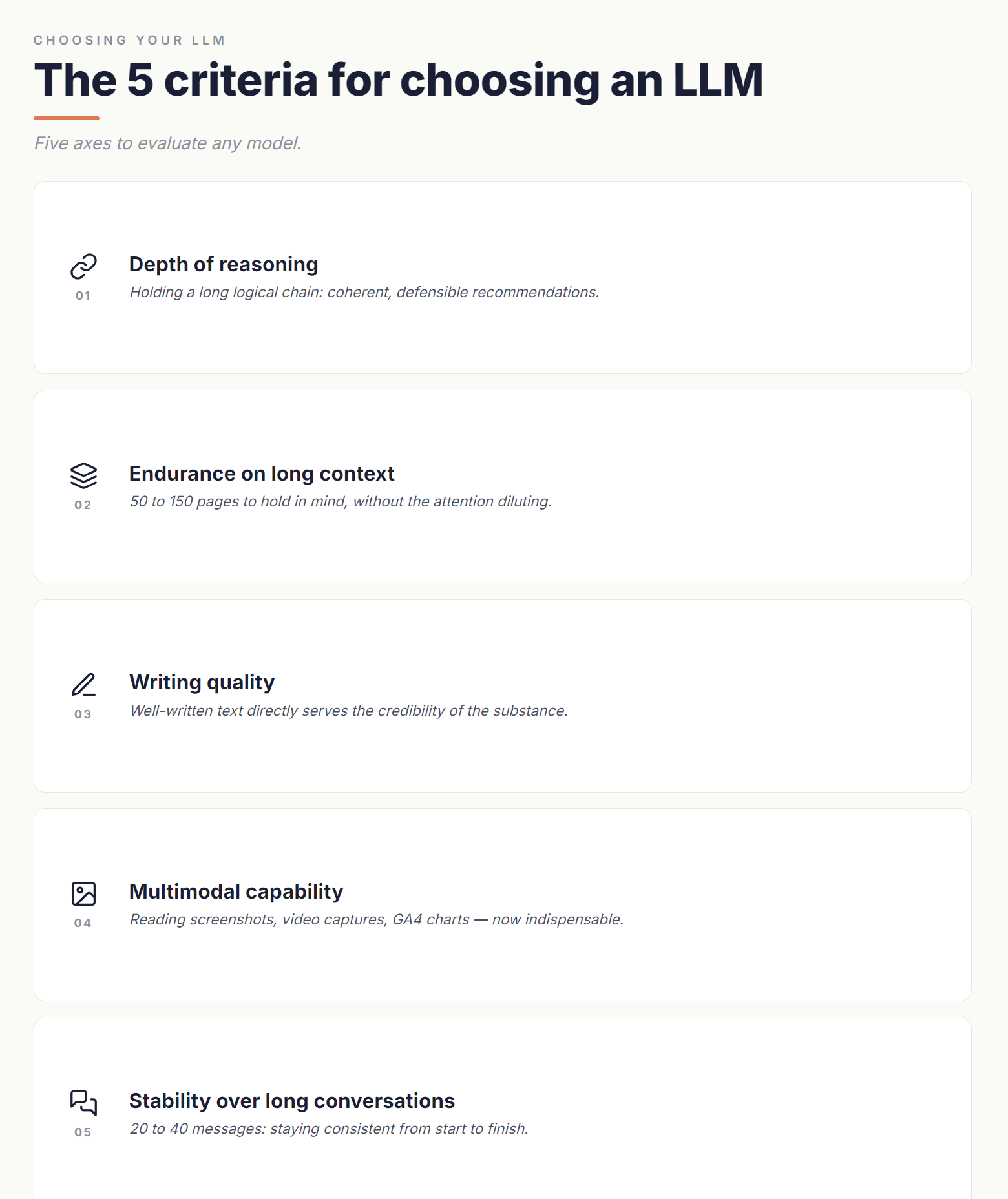
Rather than telling you "use this model," I'd rather share the evaluation grid I use to make that call — because it will still hold once the landscape has shifted.
| CRITERION | WHY IT MATTERS FOR AN AUDIT |
|---|---|
| Depth of reasoning | Strategic analysis chains together dozens of small logical steps. A model that can hold that chain produces recommendations that are coherent and defensible. |
| Endurance on long context | An audit easily draws on 50 to 150 pages of documents. The model needs to hold the full picture without its attention diluting. |
| Writing quality | The deliverables are read by decision-makers. Well-written text directly serves the credibility of the substance. |
| Multimodal capability | Reading full-page site screenshots, understanding a video capture, interpreting a GA4 chart: this has become indispensable. |
| Stability over long conversations | A complete analysis can span 20 to 40 messages. The model has to stay consistent from start to finish. |
Why Claude, today
Across these five criteria, Claude is, in my practice, the model that best goes the distance. The depth of its reasoning and the quality of its writing make it particularly well suited to strategic deliverables, where precision and consistency carry my signature with the client.
For preparatory tasks — data reformatting, first-pass reading of reports, generating structural outlines — I switch to lighter models like Sonnet 4.6 or ChatGPT. Opus is my precision tool for strategic analysis and for writing the final deliverables.
And tomorrow?
The landscape moves fast. ChatGPT is making strong progress on long context, Gemini is now a serious contender on reasoning, and new models ship every quarter. The method described here holds regardless of the model. If another LLM checks those five boxes better tomorrow, I switch.
3. Data gathering: the foundation that makes the difference
This is the first step, and it's the one that determines the quality of everything that follows. A strategic audit is only as good as the data that feeds it. And this is precisely where the expert adds value the AI cannot replicate on its own: knowing which data to collect, how to contextualize it, and how to organize it so that it produces relevant analysis.
Data gathering as an asset, not a chore
I'm not talking about simply collecting files. Data gathering is a structured process in which every resource is selected to answer a specific strategic question. On a full audit, I consistently land on four complementary families of data:
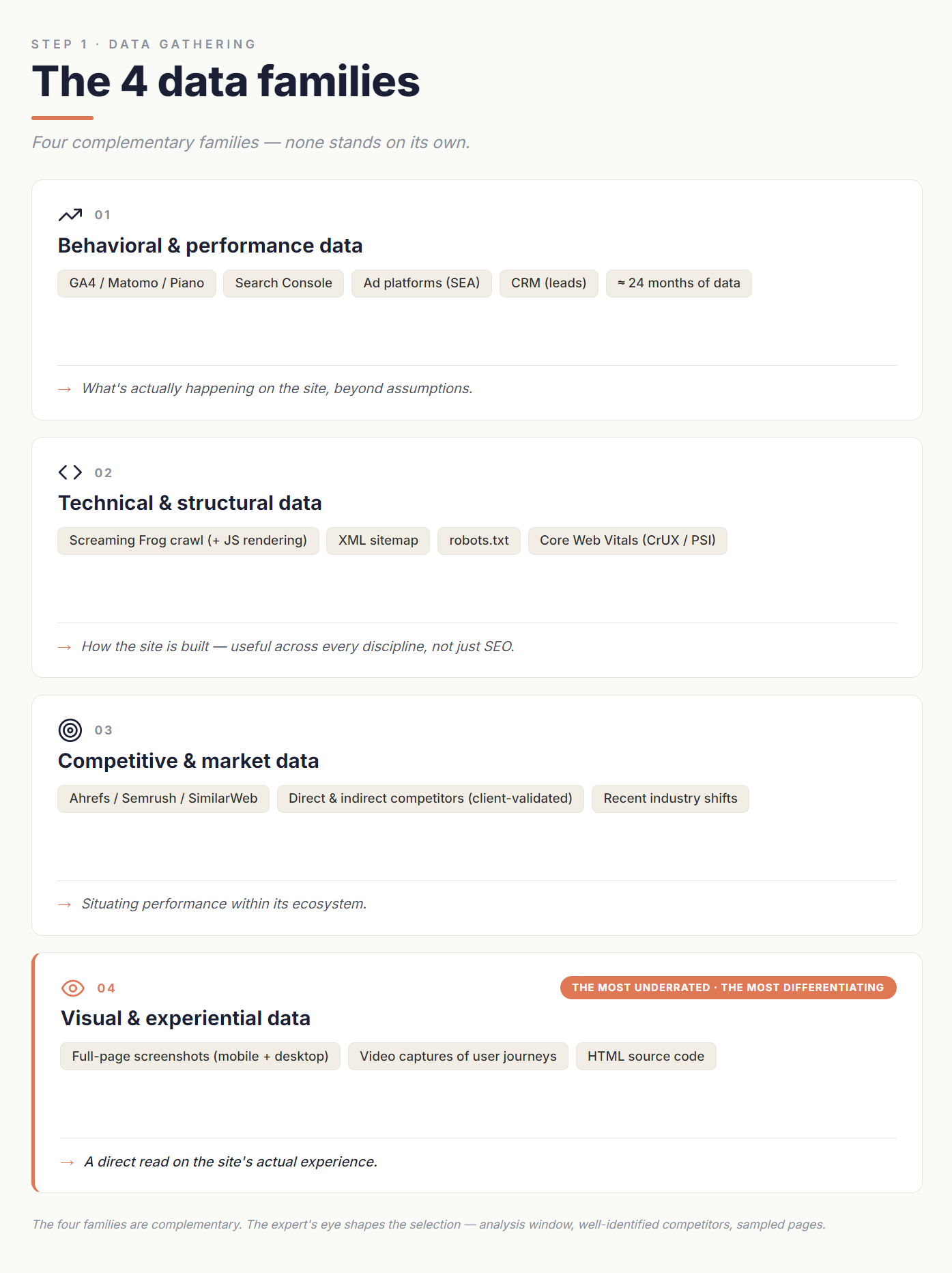
Behavioral and performance data
Full analytics exports — GA4, Matomo, or Piano depending on the stack — ideally covering 24 months to capture seasonality. Search Console on the SEO side. Ad platform exports on the SEA side. CRM data on the lead side. This data tells you what's actually happening on the site, regardless of what anyone believes is happening.
Technical and structural data
A complete Screaming Frog crawl, configured for the site (with JavaScript rendering where needed). The XML sitemap and robots.txt. Core Web Vitals from CrUX or PageSpeed Insights. Together, these let the AI understand how the site is built — useful across every discipline, not just SEO.
Competitive and market data
Third-party tool exports (Ahrefs, Semrush, SimilarWeb), an explicit list of direct and indirect competitors validated with the client, and an overview of recent shifts in the industry. This is what situates performance within its ecosystem.
Visual and experiential data
Full-page mobile and desktop screenshots of strategic pages, video captures of key user journeys, plus the HTML source code of the page. Without these, the AI has no perception of the site's actual experience. This is probably the most underrated family of data — and the most differentiating.
The expert's eye on selection
Where the method truly earns its value is in the expert's ability to choose the data that matters. A relevant analysis window, well-identified competitors, properly sampled strategic pages: these choices shape everything that follows. It's a judgment call, not a mechanical task.
This is also the stage where the expert guarantees the reliability of the sources. Incomplete or poorly scoped data flows mechanically into the final recommendations. That upstream vigilance is what separates a professional audit from guesswork.
4. The knowledge base: the project's strategic reference system
Once the data is assembled, the question becomes: how do you make this context usable by the AI — in a stable, persistent way — across all the conversations that will make up the audit?
In my practice, the answer is the knowledge base — the Claude Projects feature that lets you build a dedicated workspace, with a documentary reference system the model consults automatically at every interaction.
Far more than a folder of documents
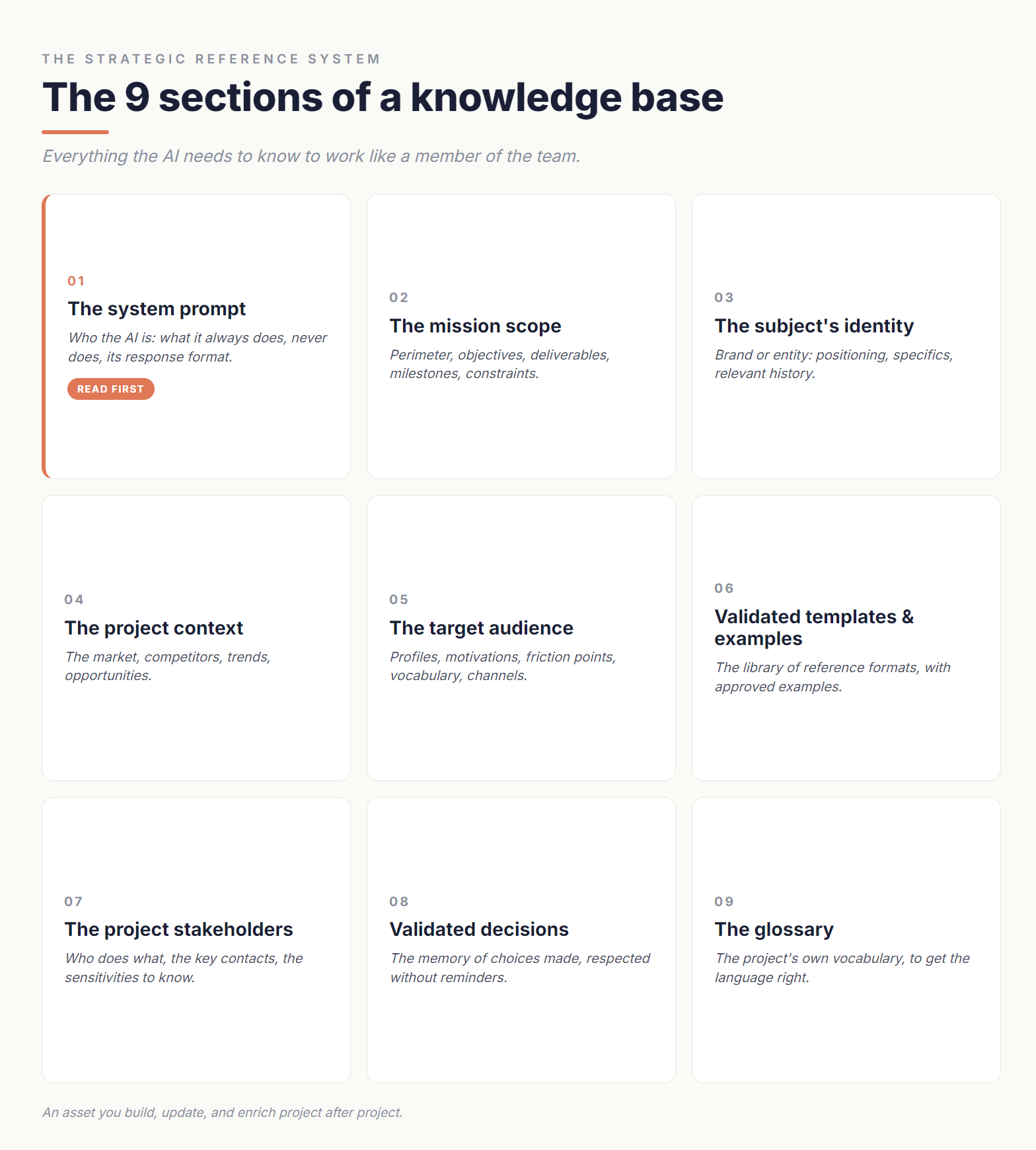
The knowledge base I use isn't a simple pile of files. It's a genuinely structured strategic reference system, containing everything the AI needs to know to work like a member of the team.
My knowledge base template is organized around nine sections, covering the behavioral frame, the business identity, and the operational context:
- The system prompt — who the AI is on this project, what it always does, what it never does, the expected response format. Read first, it conditions everything else.
- The mission scope — the perimeter covered, the objectives, deliverables, milestones, and constraints.
- The subject's identity — the brand or entity at the center of the project: positioning, specifics, relevant history.
- The project context — the market, competitors, trends, opportunities.
- The target audience — profiles, motivations, friction points, vocabulary, channels.
- Validated templates and examples — the library of reference formats, with concrete, approved examples.
- The project stakeholders — who does what, the key contacts, and the sensitivities worth knowing about.
- Validated decisions — the memory of choices already made, which the AI respects without needing reminders.
- The glossary — the project's own vocabulary, to get the language right the first time.
Each section is designed to be both readable by the AI and maintainable over time. It's an asset you build, update, and enrich project after project.
Why this structure changes everything
A well-built knowledge base transforms the quality of your collaboration with AI. Without it, every conversation starts from zero and demands a constant effort of re-contextualization. With it, the AI shows up with a stable understanding of the client — their tone, their constraints, their ecosystem — and can focus directly on the strategic analysis.
For an audit, this knowledge base is what allows the AI to produce recommendations that are never generic. They're calibrated to the client, their industry, their audiences, their actual resources. Which is exactly what you'd expect from a senior consultant who had spent weeks embedded with the client.
I've dedicated a full article to the knowledge base: its retrieval mechanics, its nine documents, and how to format and maintain them.
5. The deliverable: a master plan and its pillar annexes
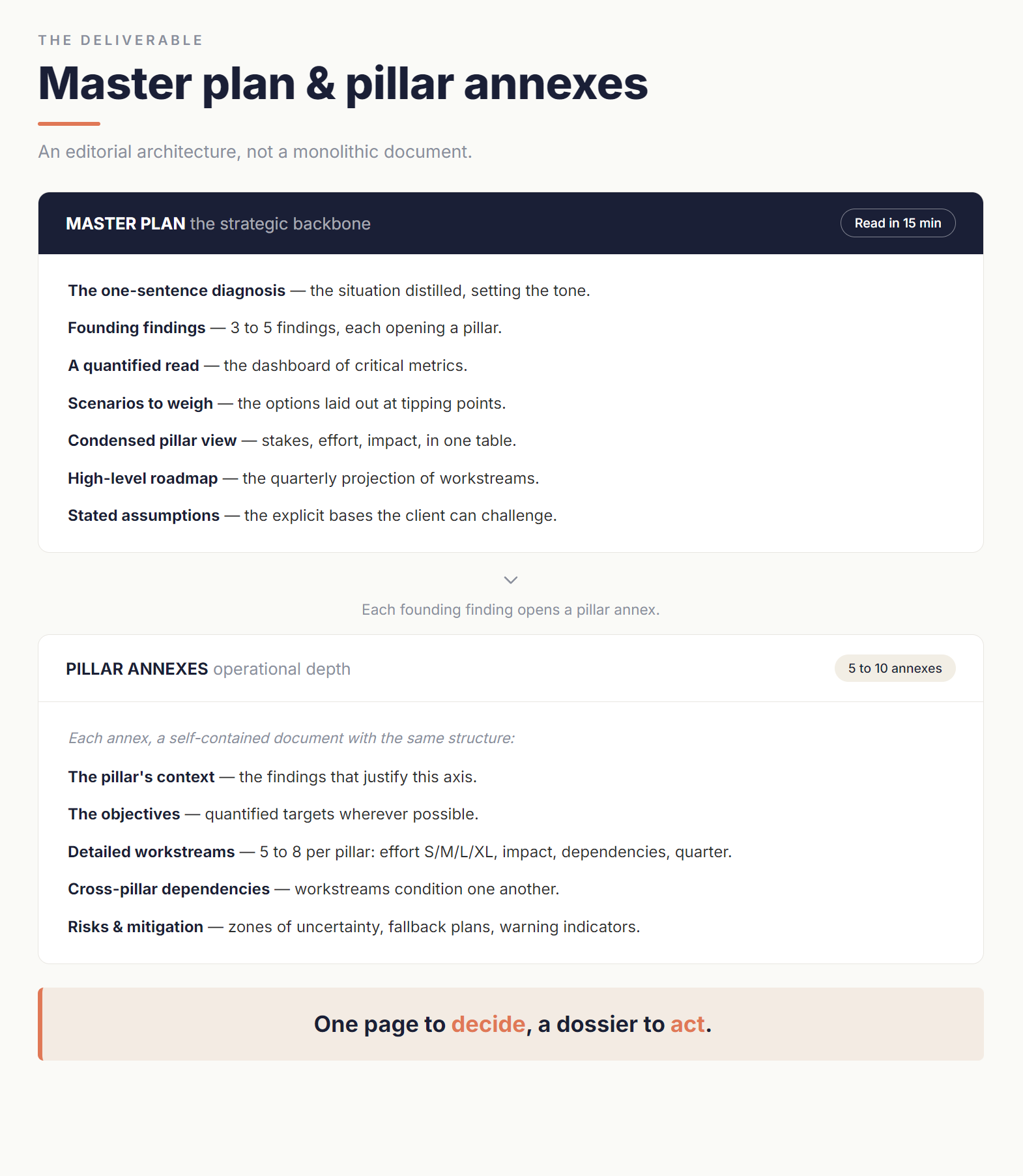
This is where the method comes into its own. The deliverable isn't a monolithic document — it's a structured dossier, a genuine editorial architecture designed to serve strategic decision-making.
Markdown: a structural choice
Every document is produced in Markdown. That's not a detail — it's a choice that directly serves the quality of the deliverable and its usability over time.
Markdown offers immediate human readability, perfect compatibility with LLMs (which can pick up, enrich, or reprocess the document later), full portability (export to PDF, HTML, or slides without losing structure), and a durability that proprietary formats can't guarantee. It's also the format best suited to version control — which becomes invaluable when an audit is meant to evolve over the long run.
I've written a dedicated article on Markdown's pivotal role in AI-assisted production.
The master plan: the strategic backbone
The first document produced — and the one decision-makers will actually read — is the executive summary, what I call the master plan. It runs a few pages, and it lays out everything that matters for understanding the situation and making the calls.
Its typical structure includes:
- The one-sentence diagnosis. A single distilled formulation that captures the situation and sets the tone for the whole dossier.
- The founding findings. Three to five consolidated findings, each backed by the data, and each mapping to an action pillar. These findings are the raw material for everything that follows.
- A quantified read of the situation. A compact dashboard of the critical metrics, grounding the diagnosis in numbers.
- The strategic scenarios on the table. When the audit identifies a tipping point, the master plan explicitly lays out the available options, their assumptions, and their business implications. The expert decides which scenarios to put on the table — the AI helps structure and argue them.
- The condensed pillar view. A table showing, for each action pillar, the stakes, the effort, and the expected impact. In one page, the decision-maker holds the strategic equivalent of the entire dossier.
- The high-level roadmap. A quarterly view projecting the workstreams over time.
- The stated assumptions. The plan explicitly documents the assumptions it rests on, so the client can challenge or validate them with full visibility.
This document is designed to be read in fifteen minutes by a decision-maker, and to serve as the reference for the entire execution of the plan. It's dense — but it's never wordy.
The pillar annexes: operational depth
Alongside the master plan, every major strategic axis gets its own dedicated pillar annex. On a full audit, you typically end up with 5 to 10 annexes, depending on the scope.
Each annex is a self-contained document, structured the same way:
- The pillar's context. The specific audit findings that justify this line of action.
- The objectives. What exactly we're aiming for, with quantified target metrics wherever possible.
- The detailed workstreams. Five to eight workstreams per pillar, each with its estimated effort (S/M/L/XL), expected impact, dependencies, and target quarter. This is the operational level — the one that lets you move straight into execution.
- Cross-pillar dependencies. Because a strategic audit is never a flat list — it's a system in which workstreams condition one another.
- Risks and mitigation measures. The zones of uncertainty, the fallback plans, the warning indicators to monitor.
This structure lets readers navigate freely: they can pick up only the annex that concerns them, or read everything starting from the master plan. Each document stands on its own while fitting into a coherent whole.
What this architecture does for the consultant
This structure isn't just a matter of presentation. It concretely changes what the consultant can do with the deliverable.
It serves the decision. The decision-maker gets a short document they can read and absorb in a single sitting. They don't have to wade through 80 pages to grasp the stakes and the trade-offs.
It serves execution. The pillar annexes translate directly into an operational work plan. Each workstream is defined precisely enough to move straight into the client's project management tool.
It serves longevity. An action plan spanning 12 to 24 months needs to be consulted, shared, and updated. The modular master-plan-plus-annexes structure keeps it maintainable over time. One annex can be revised without touching the rest. A new team member can take ownership of a pillar without having to absorb everything at once.
It serves credibility. An audit delivered in this form carries immediate authority. The rigor of the structure is itself an argument for quality — it signals that the work was thought through, not merely produced.
This is precisely the kind of deliverable a senior consultant would produce after weeks of immersion. The method gets you there without sacrificing depth — and with the expert at the center of every strategic call.
6. From deliverable to operational action plan
An audit that sits in a folder creates no value. The final step of the method turns the deliverable into a managed action plan.
Governance as the natural extension of the deliverable
The deliverable's structure is designed to make this handoff seamless. A dedicated governance pillar annex consolidates the whole: a quarterly view of the workstreams, the cross-pillar dependencies, the business decisions the client needs to make upfront, the resources required per discipline, success KPIs at 6 / 12 / 18 months, and the risks with their mitigation measures.
That annex is no cosmetic add-on. It's what turns an audit into a roadmap. It puts the client on the hook for the decisions only they can make, it sequences the actions over time, and it sets the indicators of success. Without it, even the best audit remains inert.
Handoff to the project management tool
The granularity of the workstreams in the pillar annexes — effort, impact, dependencies, target quarter — allows a direct handoff to operational tools: Asana, ClickUp, Monday, Notion, or whatever the client already uses. Each workstream becomes a task, each pillar becomes a sub-project, and the master plan's roadmap provides the sequencing.
This is the moment the audit stops being a document and becomes a living program of work. And that's exactly what you should expect from a quality strategic deliverable.
Optional: a presentation deck
For executive committees and client presentations, a slide deck is often still expected. Each section of the Markdown deliverable can then be turned into a presentation by selecting the key synthesized elements. I'll dedicate a separate article to that transformation, which follows a logic of its own — text-to-visual balance, information hierarchy, narrative.
Conclusion
What this method changes isn't the nature of expert work — it's what that expert can produce, at what depth, and at what speed. Rigorous preparation, quality scoping, and sound strategic calls remain the markers that give an audit its value. Collaborating with a model like Claude amplifies production capacity, opens up broader fields of analysis, and yields deliverables with a level of exhaustiveness that solo practice makes hard to reach.
This method is open. It adapts to your discipline, your context, your style. It will evolve with the models, and it will grow richer as practices mature. It's a working foundation, not a dogma.
Two related topics touched on here deserved their own treatment: I've explored them in depth in an article on building a knowledge base that's actually useful and another on Markdown's pivotal role in AI-assisted production. And the method doesn't stop at the deliverable: I'll extend it with an article on the posture of collaborating with AI — centaur or cyborg, and exactly where delegation should stop.
If you have experience to share from your own use of AI in audits, I'd love to hear it.